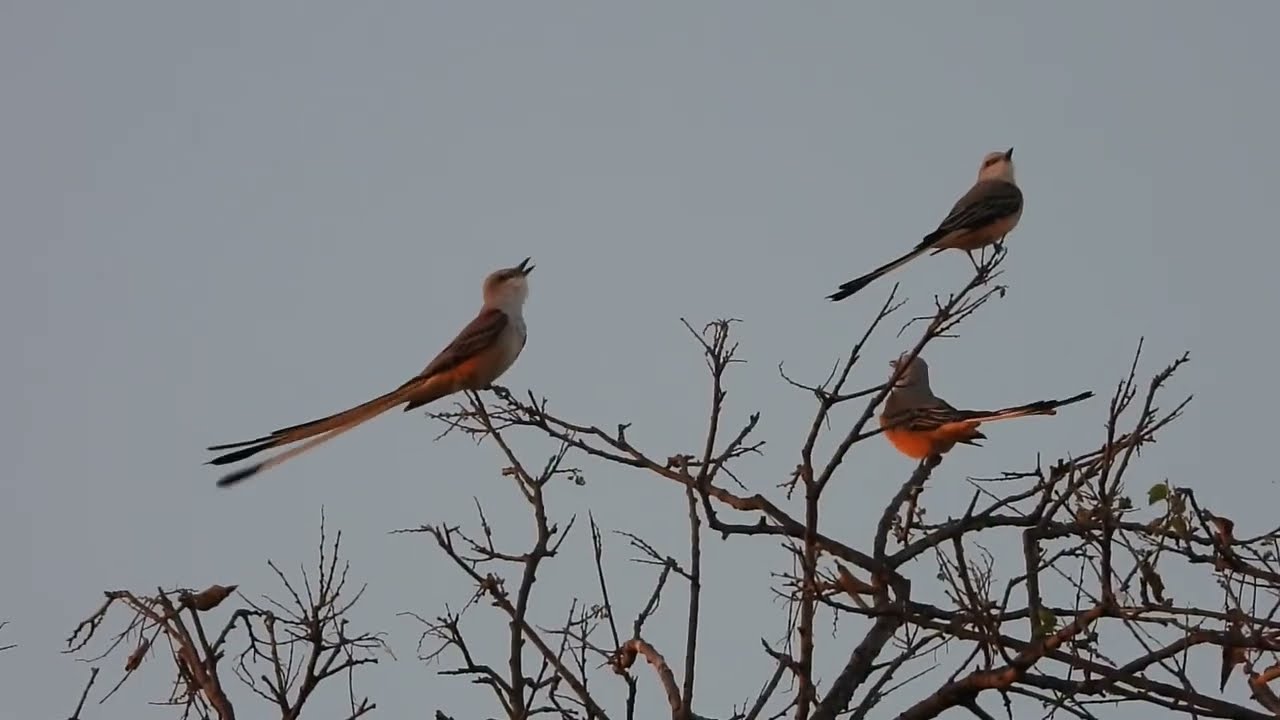
Scissor-tailed Flycatcher
Tyrannus forficatus
Conservation position Possibly enhanced in certain regions as planting of shelterbelt trees furnished much more nesting websites. Has declined in some regions in new decades.
Family members Tyrant Flycatchers
Habitat Semi-open region, ranches, farms, roadsides. Favors grassland or farmland with scattered trees or isolated groves. May well breed in open grassland without any trees in certain areas, exactly where utility poles provide artificial nest sites. Winters in open or semi-open up place within the tropics.
To the southern Wonderful Plains, this beautiful chicken is popular in summer months, normally resting on roadside fences and wires. Seen perched in a length it might counsel a slender, extended-tailed Mockingbird -- until finally it flies, displaying from the salmon-pink under the wings, its lengthy tail streamers flaring large because it maneuvers in mid-air to catch an insect. Although it appears to be special, the Scissor-tail is carefully connected to the kingbirds, and like them it can fearlessly attack greater birds that appear in the vicinity of its nest.
Photo Gallery
Scissor-Tail Flycatcher
Feeding Behavior
Forages primarily by observing from the perch, flying out to catch insects, then returning to perch to consume them. May possibly get insects in mid-air, or may choose them from foliage or from ground though hovering; very agile and maneuverable in flight.
Eggs
three-five, almost never 6. Whitish, blotched with brown and gray. Incubation is by feminine, about fourteen-seventeen days. Younger: Both mom and dad deliver food stuff to nestlings. Young go away the nest about 14-16 days soon after hatching.
Youthful
Both equally mom and dad convey foodstuff to nestlings. Youthful go away the nest about 14-sixteen days immediately after hatching.
Eating plan
Insects. Feeds mostly on insects, which includes many grasshoppers, also beetles, wasps, bees, accurate bugs, flies, caterpillars, moths, and Other people. Also eats some spiders. Small figures of berries and wild fruits are eaten sometimes.
Nesting Scissor-Tail Flycatcher
Male has stunning courtship display, sharply rising and descending in flight, its long tail streamers opening and closing, although the chook offers sharp calls. Could accomplish backwards somersaults in the air. Nest web-site is generally within a tree or tall shrub, placed on a horizontal limb or a lot less normally in a very vertical fork, usually seven-30' higher than the ground. Generally also areas nest in which wires connect to utility poles, or on other synthetic web pages for instance towers or bridge supports. Nest (built by woman) is a ragged open cup of twigs, weeds, rootlets, and grass, lined with finer resources for instance hair and plant down.
Illustration © David Allen Sibley.
Find out more about these drawings.
Textual content © Kenn Kaufman, adapted from
Lives of North American Birds
Share this chicken
Down load Our Fowl Manual Application
Migration
On the breeding grounds, frequently arrives early (by early April) and stays late (to October, even several via November). Strays wander to either Coastline, and modest numbers winter on a regular basis in southern Florida.
Scissor-Tail Flycatcher
All Seasons - Frequent
All Seasons - Uncommon
Breeding - Popular
Breeding - Unheard of
Winter season - Widespread
Wintertime - Unheard of
Migration - Typical
Migration - Unusual
See a fully interactive migration map for this species to the Chicken Migration Explorer.
Find out more
Tunes and Phone calls
A severe kee-kee-kee-kee. Also chattering notes like People of Eastern Kingbird.
Winter season group phone calls
dawn tune
pik calls
conversation phone calls #1
interaction phone calls #2
Audio © Lang Elliott, Bob McGuire, Kevin Colver, Martyn Stewart and Other folks.
Find out more concerning this sound assortment.
How Weather Alter Will Reshape the Range of the Scissor-tailed Flycatcher
Audubon’s researchers have employed a hundred and forty million fowl observations and complicated local weather products to undertaking how local climate adjust will have an affect on this hen’s selection Down the road.
Zoom in to see how this species’s latest selection will shift, develop, and deal under amplified global temperatures.
Warming scenario:
Present-day+1.five ℃+2.0 ℃+3.0 ℃
Season:
Summer season
Over-all species vulnerability standing:
Secure
a hundred forty five% array received
eighty five% assortment managed
15% assortment lost
Map Legend
Vary obtained
Enhancing
A little strengthening
Steady
A bit worsening
Worsening
Assortment lost
Vary preserved
Local climate Threats In your area
Lookup by ZIP code
or
Alabama
Weather Threats Experiencing The Scissor-Tailed Flycatcher
Pick a temperature circumstance under to see which threats will influence this species as warming increases. The same climate adjust-driven threats that place birds at risk will have an affect on other wildlife and other people, much too.
Warming situation:
+one.five ℃+3.0 ℃
Year:
Summer season
Hearth Climate
Wildfires incinerate habitat, and should they burn off regularly, avoid it from recovering.
Spring Warmth Waves
Spring warmth waves endanger youthful birds within the nest.
Scissor-Tail Flycatcher
Urbanization
Cities demolish bird habitat, and will often be located in the areas birds will need.
Scissor-tailed Flycatcher Inside the News
Extra News
News
The Nation’s Indigenous Seed Shortage Is a huge Roadblock to Ecological Restoration
Each time a wildfire burns through a landscape, land managers want to replant Using the area species that develop balanced habitats. But often they might’t—and climate transform is exacerbating the trouble
Information
Finding Up the Pen Again: JP Brammer Reignited His Passion Sketching Birds
We spoke Along with the illustrator and author who reimagined the https://wfphoto.biz/scissor-tailed-flycatcher/ Scissor-tailed Flycatcher for Audubon’s The Aviary series about inspiration, process, and building knowledge by way of artwork.
Operating Lands
Of Habitat and Hoof Prints
Quail Eternally & Audubon Conservation Ranching partnering to boost conservation grazing on the Great Plains
Investigate Equivalent Birds
The Hen Information Adopt a Chicken
Say's Phoebe
Latin: Sayornis saya
dawn tune
Jap Kingbird
Latin: Tyrannus tyrannus
dawn music #one
Fork-tailed Flycatcher
Latin: Tyrannus savana
Western Kingbird
Latin: Tyrannus verticalis
dawn tune
These birds will need your help
Get Audubon in the Inbox
Let us send you the most up-to-date in bird and conservation information.
Email deal with
Enter your electronic mail deal with
Come across Audubon Near You
Check out your neighborhood Audubon Middle, be a part of a chapter, or aid save birds using your state application.
Check out the Community
Grow to be an Audubon Member
Membership Advantages consist of one particular yr of Audubon magazine and the most recent on birds and their habitats. Your help aids protected a future for birds in danger.
Be a part of Currently
Spread the phrase. It’s the the very least you are able to do.
Keep abreast of Audubon
Get updates about our conservation do the job and the way to aid birds.
E mail tackle
Enter your electronic mail deal with
Nationwide Audubon Culture
Audubon guards birds along with the locations they require, nowadays and tomorrow.